The catamaran: a Lagoon, and what that means on the water
A Lagoon sailing catamaran with two or three crew. Wide, level and shaded where it matters, sold to 20 at most, on a shared cruise or a private one.
€100 per person · 10:00 - 15:00 · Shared seats
The boat on every Santorini cruise on this site is a Lagoon sailing catamaran, with two or three crew. It is wide and level rather than fast, with a shaded cockpit, a saloon, cabins below and a swim platform at the stern. We sell 20 places at most, on a shared cruise or a private one.
Most boat-tour pages describe the boat in adjectives. This one describes it in numbers and then tells you what the numbers actually do to your day, including the parts that are not flattering.
Specification
| Figure | What it means on the day | |
|---|---|---|
| Type | Lagoon sailing catamaran | Two hulls with a bridge deck between them. Sails, with engines for when there is no wind and inside the caldera. |
| Departure | Vlychada Marina | On the south coast. The car that is included in every cruise collects you from your hotel and brings you back, so the marina is never your problem to find. |
| Deck | Wide and level | Two hulls with a bridge deck between them, so the boat stays close to flat where a monohull would lean. |
| Below deck | Cabins and two heads | For changing, for bags and for anyone who needs to lie down. These are day cruises — nobody sleeps aboard. |
| Crew | 2–3 | A captain and one or two crew, working in Greek and English. |
| Cruising speed | 12 knots | About 22 km/h. Comfortable rather than quick. See the trade-offs table. |
| Sold capacity, shared | 20 | Twenty at most, with two or three crew on top. A shade seat each, not standing room. |
| Sold capacity, private | 20 | On a private charter the boat is yours, so the constraint is comfort rather than sharing. |
Everything above is what the operator publishes today. If anything here changes, it changes in one file and every page on this site updates with it.
A walk around the boat
The stern. You board here, over the transom, and this is where you get back in from a swim. There is a bathing platform between the hulls with a ladder down into the water. Every swim stop on every cruise happens from this platform, because none of the beaches we visit has a jetty and no boat may go alongside one without docking infrastructure.
The cockpit. A step up from the stern, under a fixed bimini. This is the shaded, seated part of the boat and it is where the table is, where lunch is served, and where most people spend the middle of the day. If the sun is the thing you are worried about, this is the answer to it.
The saloon. Through the doors from the cockpit, inside the bridge deck. Windows all round, a galley, and a place to sit out of the wind. On a windy afternoon in the caldera it is a genuinely useful room.
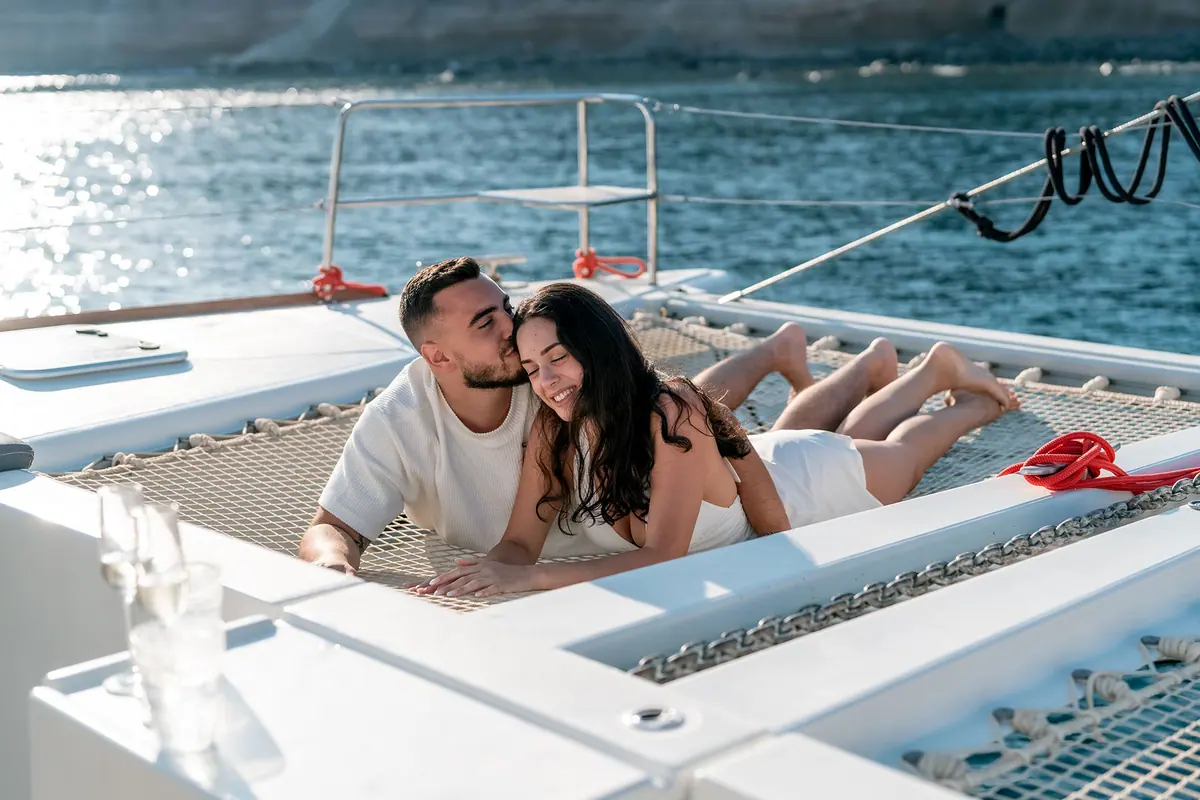
The trampolines. Forward, between the two bows: taut netting you lie on with the water running underneath you. It is the best place on the boat and it is where every photograph of a catamaran holiday gets taken. It is also completely exposed, so it is a morning-and-evening place in July rather than a one-o'clock place.
The heads. Two, in the hulls, reached down a companionway. Small, as they are on every boat this size, and worth knowing about before you need to know about it.
The grill. Aft, where the crew cook while you are in the water. Lunch is not brought aboard in a cool box; it is cooked at the hot springs while you are swimming at them.
What the width actually buys
The width between the two hulls is the whole argument for a catamaran, and it explains almost everything else about the day.
Stability. A monohull leans. That is what a sailing boat does, and on a windy afternoon in the caldera it leans a long way. A catamaran this wide stays close to level, which is why people who describe themselves as bad sailors usually do fine on one. It is not a cure for seasickness, but it removes the specific thing that most people find alarming.
Deck space. Two hulls and a bridge deck give you far more usable area than a monohull of the same length. That is why 20 people on this boat is not crowded, and why there is a shaded cockpit and a sunbathing area at the same time.
Shallow draught. Two shallow hulls instead of one deep keel. It means the boat can lie closer in at the coves on the south coast than a monohull of the same size, which is the difference between a short swim and a long one.
Getting in and out of the water. A platform between the hulls at water level, rather than a ladder over a topside. If you have ever tried to climb back onto a monohull in a swell, you already know why this matters.
What a catamaran is good and bad at
The honest version. A catamaran is the right boat for this coast, and it is not the right boat for everything.
| Good at | Not good at | |
|---|---|---|
| Comfort under way | Stays close to level; very little of the leaning that alarms people on a monohull. | It is still a boat. In a short chop a catamaran can move sharply rather than roll. |
| Space | The width gives shade, seating and sunbathing at the same time. | Nothing. This is the boat's whole point. |
| Speed | 12 knots is enough for the caldera and the south coast in five hours. | Slow if you want to cover distance. A RIB does about 20 knots and reaches places we cannot fit into an afternoon. |
| Getting close in | Shallow draught; can lie closer to the coves than a monohull. | Still anchors offshore everywhere. There are no jetties on this coast and no boat is allowed alongside a beach without one. |
| Group size | 15 to 17 people with room to sit down, and never more than that. | Above 20 you need a second boat. We will say so rather than overfill one. |
| Sailing | Sails properly when there is wind on the outside of the island. | Inside the caldera there is often either no wind or too much, so a good deal of the day is under engine. Any operator who tells you otherwise is selling you a picture. |
| Weather | Handles a Santorini summer afternoon better than most boats its size. | The captain still cancels when the meltemi is up. No hull shape argues with that. |
What travels on the boat with you
Snorkelling gear, towels and the food are all aboard. You do not need to bring any of it.
In the price
- Return road transfer between your hotel and the boat
- Greek and English speaking crew
- A meal cooked on board: BBQ chicken and shrimp off the coals, Greek salad, pasta in tomato sauce, vine leaf rolls, and Greek dips with bread
- Santorini white wine, cold beer, soft drinks and water
- Snorkelling gear
- Towels
- Captain, crew, fuel, insurance and port fees
Not included
- Walking on the volcano (the boats anchor offshore)
- Nea Kameni national park entrance fee
- Gratuities
The other boat
We also run a RIB: private, your group, two crew, about 20 knots, no cabins and no shade to speak of. It is a completely different proposition — fast, wet, loud and able to reach places the catamaran cannot fit into a day.
If you want lunch and shade and five unhurried hours, the catamaran is the boat. If you want speed, reach and a point-to-point transfer, read about the RIB and what it is for instead.
Which cruise puts you on it?
Five cruises run on this boat. Send us your dates and how many of you there are, and we will tell you which one fits.
Call the harbour office+30 698 977 1888
Common questions
What kind of boat is it?
A Lagoon sailing catamaran: two hulls with a bridge deck between them, two or three crew, cruising at about 12 knots. The width is the part that matters, because it is what gives the boat a shaded cockpit, a saloon inside, cabins below and a sunbathing area forward, all at the same time.
How many people are on board?
We sell twenty places at most, as seats on a shared cruise or as the whole boat on a private one — plus two or three crew either way. Stopping at twenty is the difference between everyone having somewhere shaded to sit and nobody having anywhere.
Is a catamaran better than a monohull for seasickness?
It is better at the specific thing most people dislike, which is leaning. The width between the hulls keeps the boat close to level where a monohull would heel. It is not a cure — a short chop still moves a catamaran — but it removes the alarming part.
Do you actually sail, or just motor?
Both, and honestly it depends on the day. There is often either no wind inside the caldera or far too much, so a good part of most days is under engine. On the outside of the island in a steady breeze the sails go up properly.
Are there toilets on board?
Two, down a companionway in the hulls. They are small, as they are on every boat this size. There is fresh water aboard and a place to change in the cabins, which most people use before and after the swim stops.
Can the boat get close to the beaches?
Closer than a monohull, because two shallow hulls draw less than one deep keel — but it still anchors offshore everywhere. None of the swim stops has a jetty and no boat is allowed alongside a beach without docking infrastructure. You go in from the platform at the stern.
Santorini Boat Tour - Water Taxi is a catamaran cruise and water taxi operator based in Fira, Santorini.
Updated August 2026